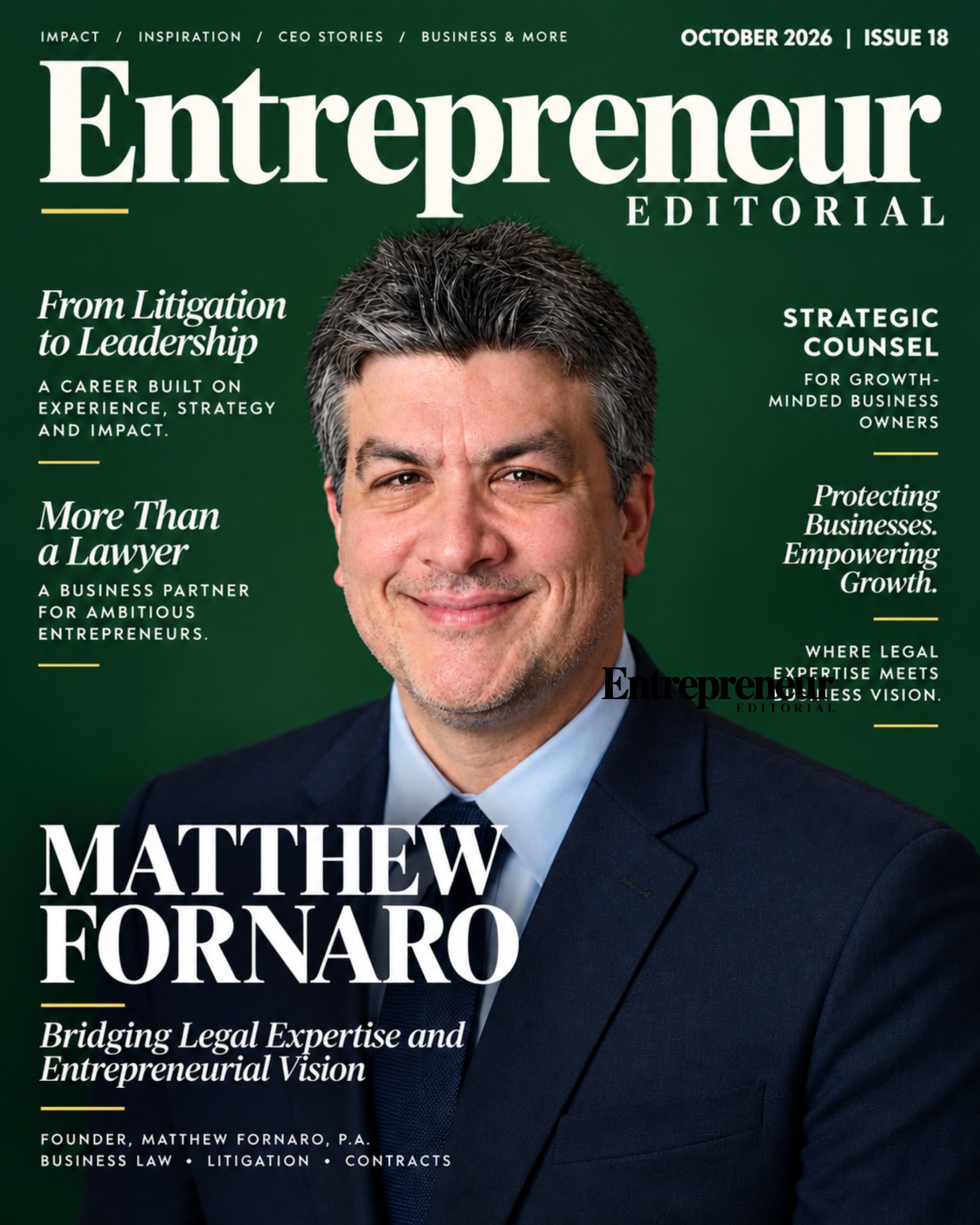
How a Career in Litigation Became a Mission to Empower Business Owners
In the world of entrepreneurship, success is often measured by growth, innovation, and the ability to turn an idea into a sustainable business. Yet behind every successful enterprise lies a framework of decisions, agreements, responsibilities, and risks that can shape its future. Contracts must be carefully structured, partnerships require trust, and disputes must be handled with precision. For entrepreneurs navigating these challenges, the right legal guidance can make a meaningful difference.
For Matthew Fornaro, founder of Matthew Fornaro, P.A., the practice of law has always been about more than interpreting statutes or resolving disputes. It is about understanding the people behind the businesses, recognizing the challenges they face, and helping them make informed decisions that protect what they have worked hard to build.
With a legal career that began in 2003, Fornaro has spent more than two decades developing his experience in civil and commercial litigation, business law, contracts, transactions, and commercial disputes. His professional journey, shaped by years at established law firms and his experience as a business owner, has led him toward a clear objective: making sophisticated legal guidance accessible, practical, and relevant to entrepreneurs and small and midsize businesses.
Through Matthew Fornaro, P.A., established in 2015, he has built a practice centered on the intersection of legal strategy and business realities. His approach reflects an understanding that business owners need more than technically correct legal answers. They need counsel that considers their objectives, resources, relationships, and long-term ambitions.
The Foundations of a Legal Career

Fornaro began his legal career in 2003 after graduating from the University of Florida Levin College of Law. His early professional experience focused on civil and commercial litigation, introducing him to the complex processes involved in resolving disputes between individuals, organizations, and businesses.
The work required a disciplined approach to legal research, pleadings, discovery, hearings, trials, and dispute resolution. Each matter demanded careful preparation, a thorough understanding of the relevant facts, and the ability to assess the strengths and weaknesses of competing positions. Over time, these experiences helped establish the analytical foundation that continues to inform his work.
Litigation also offered an important perspective on the consequences of business decisions. Disagreements involving contracts, financial obligations, ownership interests, and commercial relationships can affect more than the immediate parties to a dispute. They can disrupt operations, consume resources, strain professional relationships, and divert attention from growth.
For entrepreneurs, such challenges can become especially demanding because business decisions are often closely connected to their livelihoods and long-term plans.
As Fornaro’s career progressed, he practiced at established firms, including Greenspoon Marder and Shutts & Bowen. Working in larger law-firm environments exposed him to sophisticated legal matters and reinforced the importance of preparation, precision, and professional judgment.
These experiences helped shape his understanding of what effective legal representation requires. A strong legal strategy must be grounded in the facts and the law, but it must also account for the client’s circumstances and desired outcome.
Over time, Fornaro recognized an opportunity to apply that experience in a setting more directly aligned with the needs of business owners.
From Established Firms to Building an Independent Practice

Founding a law firm represents a significant professional transition. It requires more than legal expertise; it demands business judgment, operational discipline, relationship management, and a willingness to take responsibility for building an organization from the ground up.
In 2015, after more than a decade of practicing law, Fornaro established Matthew Fornaro, P.A.
The decision marked a defining milestone in his career. It allowed him to bring the experience he had developed in larger firms into an independent practice designed around the practical concerns of entrepreneurs and businesses.
Building his own firm also gave him firsthand exposure to the responsibilities that accompany business ownership. Lawyers who advise entrepreneurs must understand that decisions are rarely made in isolation. A contract negotiation, for example, may involve not only legal obligations but also cash flow, customer relationships, operational timing, and future expansion plans.
Similarly, resolving a commercial dispute may require balancing the legal merits of a position against the potential cost, time, and commercial consequences of pursuing it.
Running a firm strengthened Fornaro’s appreciation of these competing considerations. He understands that business owners need clear explanations of their options and realistic assessments of the risks involved. They need to know not only what the law permits, but also how different choices may affect their businesses.
The establishment of Matthew Fornaro, P.A. therefore represented more than the creation of an independent legal practice. It reflected a deliberate effort to bring experienced legal counsel closer to the everyday decisions that determine a business’s direction.
Addressing the Gap Between Legal Sophistication and Business Reality
One of the central ideas guiding Fornaro’s practice is the gap between the sophisticated legal resources available through large firms and the practical needs of small and midsize businesses.
Entrepreneurs routinely encounter legal questions as they establish, operate, and expand their companies. They may need assistance reviewing agreements, structuring transactions, resolving ownership disagreements, negotiating commercial arrangements, or addressing disputes with customers, suppliers, partners, or other businesses.
For many companies, however, the traditional structure of a large law firm may not always align with their needs, budgets, or operational circumstances.
At the same time, business owners cannot afford to treat important legal questions casually. An unclear agreement or poorly understood obligation can create uncertainty that becomes increasingly difficult to resolve as a company grows.
Fornaro’s objective is to bridge this divide by offering experienced, business-focused legal guidance through a more direct and practical approach.
His philosophy recognizes that effective counsel begins with understanding the client’s broader situation. A business owner facing a contractual disagreement, for instance, may be concerned about more than the immediate legal issue. The disagreement could affect an important customer relationship, delay a project, create financial uncertainty, or interfere with future opportunities.
Understanding those considerations allows legal advice to be framed around the client’s actual objectives.
This does not mean compromising legal standards or overlooking risk. Rather, it means explaining legal issues in a way that helps clients understand the available options, the potential consequences, and the considerations that should inform their decisions.
For Fornaro, accessibility and sophistication are not opposing qualities. A legal practice can draw upon substantial experience while communicating clearly and focusing on the practical needs of the people it serves.
A Business-Oriented Approach to Legal Counsel

What distinguishes Fornaro’s professional philosophy is the combination of extensive litigation experience, independent business ownership, and an appreciation for the realities of entrepreneurship.
His litigation background provides a framework for analyzing disputes, evaluating evidence, and understanding how disagreements can develop into costly legal matters. His experience building his own firm offers another perspective: the daily decisions required to manage an organization, serve clients, maintain relationships, and plan for sustainable growth.
Together, these experiences influence how he approaches business law.
Rather than viewing a legal question solely as a technical problem, Fornaro considers the business objective behind it. What is the client trying to accomplish? Which risks require immediate attention? What alternatives are available? How might a particular decision affect the company’s finances, reputation, relationships, or future opportunities?
These questions help place legal analysis within the larger context of business decision-making.
Contracts illustrate this approach particularly well. An agreement is not simply a collection of clauses. It establishes expectations, allocates responsibilities, and creates a framework for how parties will work together. When carefully prepared and understood, it can help reduce uncertainty and provide a clearer path for addressing disagreements.
Likewise, commercial disputes require an assessment of both legal position and business priorities. The appropriate strategy depends on the circumstances of the matter, the client’s objectives, and the realistic consequences of the available courses of action.
Fornaro’s approach emphasizes helping clients understand those choices rather than presenting legal advice disconnected from the decisions they must make.
The ultimate objective is to provide clarity. When business owners understand their rights, obligations, and options, they are better positioned to make deliberate decisions and move forward with greater confidence.
Recognition Built on Professional Standards
Among the milestones Fornaro values is receiving an AV Preeminent rating from Martindale-Hubbell, a recognition associated with peer assessments of professional ability and ethical standards.
For him, the significance of this achievement extends beyond an individual professional distinction. It reflects values that have remained central throughout his career: competence, integrity, and the importance of earning the confidence of clients and fellow professionals.
Legal practice depends heavily on trust. Clients often seek counsel when they are facing uncertainty, making consequential decisions, or managing disagreements that may affect the future of their businesses. In such circumstances, professional judgment and clear communication are essential.
Recognition from peers can serve as one measure of professional standing, but maintaining that standing requires consistent attention to the responsibilities of the profession.
Fornaro’s career milestones—the establishment of his own firm and the recognition of his professional abilities—represent complementary dimensions of achievement. One reflects the initiative required to build an independent business; the other reflects the importance of maintaining professional standards while doing so.
Both align with his broader understanding of success as something developed over time through responsible work, meaningful relationships, and a commitment to serving others.
Beyond Legal Practice: Supporting the Entrepreneurial Community
Fornaro’s interest in entrepreneurship extends beyond his work with individual clients. He also plans to continue contributing to entrepreneurship education through programs such as SCORE, Kauffman FastTrac, and the Jim Moran Institute.
These initiatives provide opportunities to engage with business owners and aspiring entrepreneurs on the practical challenges associated with establishing and developing businesses.
Entrepreneurship involves a wide range of responsibilities, from identifying a market opportunity and managing finances to developing customer relationships and building an effective team. Legal considerations are part of that broader picture, yet they are not always addressed early enough in a company’s development.
Many entrepreneurs concentrate initially on creating a product, acquiring customers, and generating revenue. Questions about contracts, ownership arrangements, business obligations, and dispute prevention may receive less attention until a problem arises.
Fornaro’s broader educational interests reflect the value of helping entrepreneurs understand these issues before they become urgent.
Through continued participation in educational initiatives, along with writing, speaking, podcast appearances, and media engagement, he aims to make business-law concepts more accessible to a wider audience.
The objective is not simply to explain legal rules. It is to help business owners recognize when legal questions matter, understand why preparation is important, and identify opportunities to address potential problems before they become expensive distractions.
This educational dimension complements his legal practice by extending the conversation beyond individual cases and toward a broader understanding of responsible business development.
Looking Ahead: Expanding Reach While Preserving Personal Service

Looking toward the future, Fornaro’s plans center on growing Matthew Fornaro, P.A. while preserving the direct, practical approach that has defined the firm.
He intends to continue expanding his work with entrepreneurs and businesses in Florida and New York, with particular attention to business transactions, contracts, commercial disputes, and strategic legal planning.
These areas reflect the many stages at which businesses require legal guidance. A company may need help establishing sound contractual relationships in its early years, navigating more complex transactions as it grows, or resolving disputes that threaten its operations.
For established businesses, legal planning can also support continuity and help decision-makers assess risks before committing resources to significant opportunities.
As businesses become more complex, the need for informed decision-making becomes increasingly important. Fornaro’s ambition is to continue providing guidance that recognizes both the legal dimensions of business activity and the commercial realities that influence each decision.
He also plans to deepen his involvement in entrepreneurship education and public-facing professional communication. Writing, speaking, podcasts, and media features offer opportunities to discuss business-law issues in language that entrepreneurs can understand and apply to their own circumstances.
The common thread connecting these goals is accessibility. Whether advising a client, contributing to an educational program, or discussing a legal issue with a broader audience, Fornaro seeks to make useful legal knowledge more available to the people who need it.
Defining Success Through Trust and Lasting Value
For Fornaro, success cannot be reduced to a single case, award, or financial result. It is a broader measure of whether a career and a business remain sustainable, respected, and useful to the people they serve.
Professionally, success means helping clients protect what they have built, resolve difficult problems, and make decisions with a clearer understanding of their options. It means maintaining integrity, continuing to develop professionally, and building relationships founded on trust.
His definition also extends beyond the workplace. Spending meaningful time with his family remains an important part of the life he wants to build, reinforcing his belief that professional achievement should exist alongside personal priorities.
This perspective offers a measured view of entrepreneurship itself. Building a successful business is not simply about reaching a particular milestone. It involves making responsible choices, adapting to challenges, maintaining relationships, and creating value that endures.
The same principles inform Fornaro’s approach to legal practice. The purpose of counsel is not merely to respond to problems as they arise, but to help clients understand their circumstances and move toward decisions that support their broader objectives.
Building Confidence Through Clarity

Matthew Fornaro’s professional journey reflects the evolution of a lawyer who has combined years of litigation experience with the responsibilities of independent business ownership to develop a practice focused on entrepreneurs and growing companies.
From his early work in civil and commercial litigation to founding Matthew Fornaro, P.A. in 2015, his career has been shaped by a consistent interest in helping people navigate complex decisions with greater clarity.
His work addresses a fundamental challenge in the business world: legal issues are rarely separate from commercial realities. Contracts influence relationships, disputes affect operations, and decisions made today can shape a company’s opportunities tomorrow.
By connecting legal analysis with the practical needs of business owners, Fornaro seeks to make experienced counsel more relevant to the decisions entrepreneurs face every day.
As he continues to develop his practice and expand his involvement in entrepreneurship education, his focus remains on helping business owners understand their options, manage risk, and protect the organizations they have worked to build.
Ultimately, his vision of professional achievement rests on a straightforward principle: meaningful legal service should help people make better decisions. Through experience, preparation, and a commitment to practical guidance, Matthew Fornaro continues to pursue that objective—supporting entrepreneurs not only when challenges arise, but also as they work toward building stronger, more sustainable businesses.